 Cyber
Cyber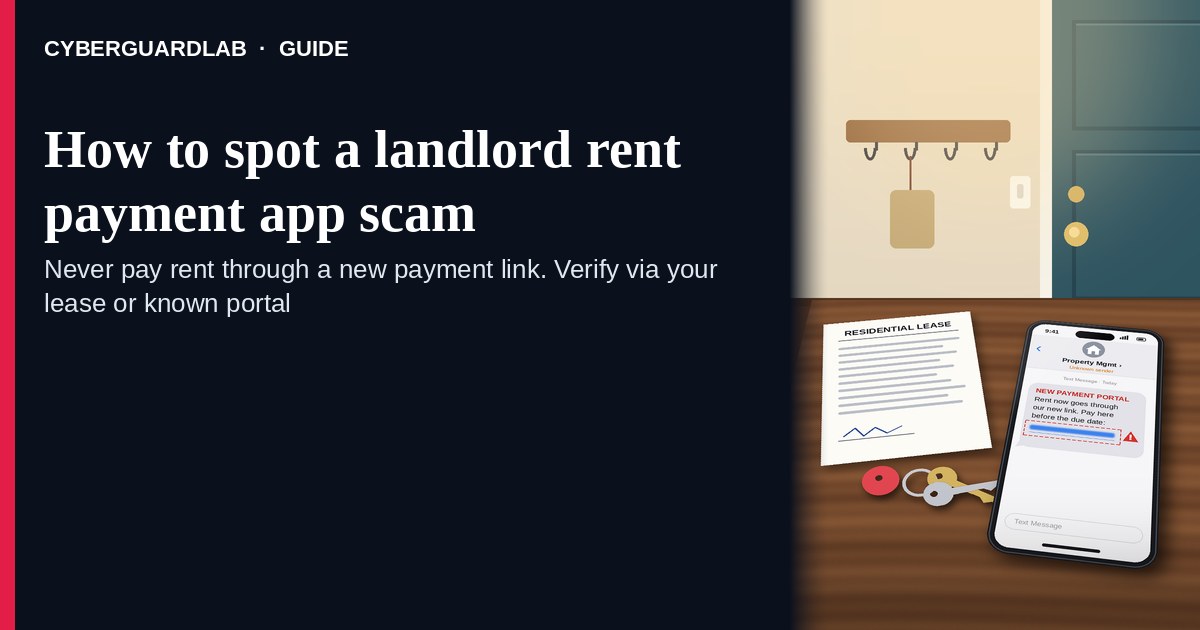
A landlord rent payment app scam is an unexpected email, text, or listing message that tells you to pay rent (or a deposit) through a new Zelle, Venmo, Cash App, Bitcoin, gift-card, or “updated portal” link — often after a real apartment listing, a stolen lease identity, or a mid-month “property manager changed” note. Real rent instructions should match a channel you already trust from the lease signing or the portal you already use. The FTC’s rental and payment guidance is clear: beware of landlords who push you to wire, gift-card, or person-to-person app payments before you have verified the property and the person; never send money to a cold new payee just because an email or text said “new payment method.” Verify payment instructions only through a channel you already trust (in-person lease, known portal, phone number from the signed lease). This lure overlaps Venmo payment request and Zelle / Cash App payment scams but focuses on the landlord / rent costume. CyberGuardLab is independent. Referral fees may affect product placement on other pages. Buying nothing and sticking to free verification habits is a valid outcome.
The short answer
Do not pay rent or deposits through a cold new Zelle / Venmo / Cash App / portal link from an unexpected “landlord” message; verify payment instructions only through a channel you already trust from the lease or known portal.
What a landlord rent-app scam usually looks like
Scammers copy property-manager language: “new ownership,” “updated rent portal,” “pay this month via Zelle only,” or “deposit to hold the unit.” The job is irreversible person-to-person payment theft or a phishing page that steals banking logins.
Common shapes US households report:
- Too-good listing or remote “landlord” who never shows the unit in person and demands a deposit by Venmo, Zelle, Cash App, wire, or crypto before keys.
- Mid-lease email or text claiming the property manager changed and rent must now go to a new app handle or “secure portal” link.
- Look-alike rent portal after you tap — then bank login, card, or “instant verification” harvest.
- Pressure + isolation — “pay in 2 hours or eviction / unit goes to another applicant,” and they discourage phone or in-person checks.
- Follow-up after any small payment — once money moves, they ask for “fees,” “insurance,” or a second month. Same P2P money-out pattern as Venmo and Zelle / Cash App scams; utility-style urgency cousins: Utility shutoff scam.
FTC rental / payment guidance themes: verify the landlord and property; be cautious with payments that are hard to reverse; do not send money based only on an unexpected message. Report at ReportFraud.ftc.gov.
We do not claim every landlord “never uses Venmo.” Some small landlords do use apps. The safe habit is always the same: payment method changes must be confirmed through a channel you already trust — not through the cold message that announced the change.
Fake rent-app ask vs real landlord notice vs related P2P scams
| Signal | Fake landlord rent-app ask | Real landlord / portal notice (typical) | Related Venmo / Zelle / Cash App scam |
|---|---|---|---|
| Opening hook | “New manager — pay rent via this Zelle / Venmo / new portal.” | Payment details that match your signed lease or the portal you already use. | “You sent money by mistake — refund me” or fake goods payment request. |
| Ask | Cold app handle, crypto, gift cards, or look-alike portal login. | Same payee / portal as before, or a change confirmed in person / known phone. | Send or reverse money inside the app to a stranger. |
| Pressure | Same-day eviction, “unit reserved only after deposit,” portal lockout. | Normal due date; you can confirm before changing methods. | Countdown refund or “account restricted” fear. |
| Safe next step | Do not pay. Confirm via lease phone, in-person, or known portal. | Pay only using the verified method you already trust. | See Venmo / Zelle–Cash App guides; never send to cold requesters. |
| Related guide | This page | Your signed lease + known portal | Venmo payment request · Zelle / Cash App |
If the only “proof” of a new payee is the email or text that asked for money, stop — that is not verification.
How to verify a landlord rent payment ask (US household steps)
Do this when any unexpected rent / deposit / “new portal” payment message appears. You do not need a paid product to finish these steps.
- Do not send Zelle, Venmo, Cash App, wire, crypto, or gift cards from the unexpected message. Do not tap the “new portal” link or call a number that lives only inside that message.
- Confirm payment instructions through a channel you already trust. Use the phone number or office address on your signed lease, visit the office in person, or sign into the rent portal you already bookmarked — not the new link in the text.
- For a new listing, verify the property and the person before any deposit. Prefer an in-person tour; check whether the person listing the unit has the right to rent it; be wary of remote-only landlords who refuse normal verification. FTC consumer pages on rental scams stress verifying the landlord and avoiding hard-to-reverse payments.
- Never change payees because one email said “ownership changed.” A real change should survive a call to the prior number on your lease or an in-person check. Treat sudden app-only deposits as high risk.
- If you already sent money or typed a bank login, treat it as incident response. Contact your bank or the payment app’s help channel immediately; person-to-person payments are often hard to reverse. Change any password you typed. Follow Clicked a phishing link — first hour if a portal login was involved. Report at ReportFraud.ftc.gov; if identity data was stolen, use IdentityTheft.gov.
- Report the message and tell the household. Forward scam texts to 7726 (SPAM); mark phishing emails as junk; file at ReportFraud.ftc.gov. Agree that rent method changes need a trusted-channel confirm. Broader text habits: Spam text messages. Checklist: How to report a scam to the FTC.
Signs the rent ask is fake or unsafe (scan table)
Use this as a quick pass before you send money.
| Sign | Why it matters | What to do |
|---|---|---|
| New Zelle / Venmo / Cash App / crypto payee appears only in a cold email or text | P2P payments are often irreversible | Do not send; confirm via lease / known portal |
| Remote landlord refuses a tour and demands a deposit first | Classic fake-listing pattern | Walk away until you verify the property in person |
| “Updated portal” link is a shortener or odd domain | Phishing page for bank logins | Never tap; open the portal you already trust |
| Urgent eviction / “unit holds for 2 hours” after a method change | Fear used to skip verification | Slow down; call the number on your lease |
| They ask for gift cards, crypto, or wire “to hold the apartment” | Hard-to-reverse payment types scammers prefer | Refuse; verify landlord through trusted channel |
| You already sent a deposit to a new app handle | Money may be gone; follow-up fee asks common | Contact bank/app help now; report at ReportFraud.ftc.gov; stop further payments |
Free habits that reduce the blast radius
You do not need a new subscription to lower damage if a fake rent-app ask gets through.
- Keep your signed lease and the real office / portal contacts in one place; use those when anything “changes.”
- Household rule: never send rent or deposits to a brand-new app handle from an unexpected message.
- Prefer payment methods and portals that create a clear record with a landlord you have verified.
- Strong unique passwords + 2FA on email and banking limit what a stolen portal login can unlock.
- Optional antivirus / web filtering is a separate layer after a bad portal tap; it does not replace trusted-channel verification before you send rent.
What this page is not
This page is not legal advice about a specific eviction, lease dispute, or chargeback, and not a ranking of rent-payment apps.
It does not claim CyberGuardLab lab scores or “#1 anti-fraud” ranks. It does not tell you to skip paying legitimate rent you owe on a verified lease — it tells you to verify who and where before you change methods. Official recovery and reporting stay with your bank or payment app, ReportFraud.ftc.gov, and IdentityTheft.gov if personal data was stolen. For app-specific money-request tricks, see the Venmo and Zelle / Cash App guides linked above.
If you decide a paid extra is a real job
Most households can handle fake landlord rent-app asks with the free steps above. Open a paid page only if you already named a job — for example broader web filtering, cross-device AV, or identity alerts after you gave a scammer personal data — and you will actually use it.
- PC / Mac suite with phishing and web protections many households already compare: Norton plans (paid link; confirm renewal price).
- Independent-test–oriented suite option: Bitdefender plans (paid link).
- Household suite shopping starting point: TotalAV plans (paid link; confirm renewal).
- Multi-device bill under one vendor: McAfee plans (paid link; confirm device limit).
- Another suite path some homes already use: Avast plans (paid link).
Buying nothing beyond free trusted-channel verification habits is still valid. Paid links above are on-site only.
FAQ
Can a real landlord ask for rent on Venmo or Zelle?
Some small landlords do. That is why the safe test is not “apps are never used,” but “I only pay a method I verified through the lease, an in-person confirm, or the portal I already trust — not a cold new handle in a surprise email.”
The email looks like it came from my property manager. Is that enough?
No. Display names and even familiar-looking addresses can be spoofed or look-alike. Call the number on your signed lease or visit the office; do not trust the Reply thread alone for a payee change.
I already sent a deposit by Zelle / Venmo / Cash App. What should I do first?
Contact your bank or the app’s help channel immediately and explain it may be a scam. Do not send “fees” or a second payment. Report at ReportFraud.ftc.gov. If you also typed a portal password, follow Clicked a phishing link — first hour.
How is this different from a generic Venmo or Zelle scam page?
Those guides cover broad fake payment requests and refund tricks. This page focuses on the rent / landlord / new portal costume — listing deposits and mid-lease “pay here now” switches. Related: Venmo payment request scam and Zelle / Cash App payment scam.
How do I report a landlord rent payment scam?
Forward scam texts to 7726 (SPAM), mark phishing emails as junk, and file at ReportFraud.ftc.gov. Steps for the FTC side are in How to report a scam to the FTC.
Do I need paid antivirus to spot these asks?
No. Spotting is a verification habit: confirm payees through the lease or known portal, never send rent to a cold new app handle. Antivirus can be a separate optional layer for malware after a bad portal tap; it does not replace that habit.