 Cyber
Cyber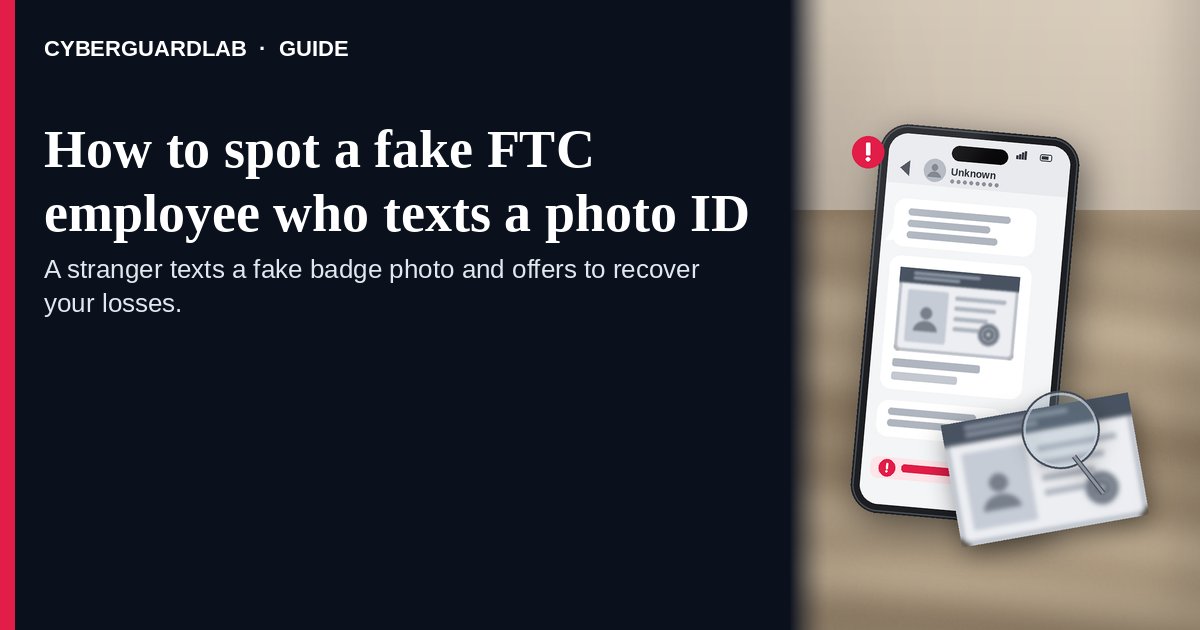
A fake FTC employee photo-ID text is an unexpected SMS or messaging-app note from a stranger who claims to work at the Federal Trade Commission, says they can help you get back money lost in an earlier scam, and then sends a picture of an employee ID or badge to “prove” who they are. The FTC’s June 2026 consumer alert describes exactly that pattern: the contact is unknown, the “agent” story is false, the ID photo is fake, and the real goal is a refund-and-recovery scam that seeks money or financial access. A related May 2025 FTC alert covers a different channel — phone calls that invent FTC “agents,” fake badge numbers, and ID cards after a tech-support, Amazon, or bank scare — and notes that the FTC does not have “agents.” This page is about the unexpected text or WhatsApp-style message that arrives with a fake employee photo ID and a recovery pitch. Broad SSA/IRS/Medicare impersonation is covered in How to spot a Social Security scam. CyberGuardLab publishes independent consumer guides. Elsewhere on the site some product pages may earn referral fees that can influence which products are listed. Every step on this page is free; paid software is optional and appears only at the end.
The short answer
Ignore any unexpected text or messaging-app contact that claims to be an FTC employee and can recover prior scam losses. A real FTC employee will not reach you by text or WhatsApp, will not text a photo of an employee ID to verify identity, and will not ask you to pay them, move money into an account they name, or hand over financial details. If you already paid or shared account access, try to cancel or reverse the transfer right away, tell your bank or app, and report at ReportFraud.ftc.gov.
How a fake FTC employee photo-ID text works
Official FTC alerts describe a short trust-building script:
- An unexpected message lands from a contact you do not know. The FTC’s June 2026 alert says the first contact is an unexpected message from an unknown sender — SMS or a messaging app such as WhatsApp.
- They claim to be an FTC employee or “agent” who can recover losses. The same alert says the sender pretends they can help you recover money lost in a previous scam. They cannot. The May 2025 alert adds that the FTC does not have “agents,” even when a caller invents a badge number.
- They send a photo of an employee ID and a badge. The June 2026 alert says the photo is meant to “verify” identity and gain trust — and that the ID and badge are all fake.
- The ask is money, a fund move, or financial information. The June 2026 alert frames this as a refund-and-recovery scam: pay them, move money into an account they specify, or give financial information. The May 2025 alert’s phone variant has the same end goal — convince you to transfer money out of your account.
- Urgency and “protection” language keep you moving. Government-impersonation guidance on consumer.ftc.gov warns that real agencies will not call, email, text, or message you on social media to ask for money or personal information, and that nobody from the FTC will ask you to move money (or connect you to someone who does).
- Payment methods that are hard to reverse are preferred. The government-impersonation article warns against wiring money or paying with gift cards, cryptocurrency, or a payment app to anyone who says they are with the government — those channels are hard to track and hard to reverse.
Fake FTC photo-ID text vs real FTC contact vs related lure
| Signal | Fake FTC photo-ID text | Real FTC contact | Related lure (phone “FTC agent” handoff) |
|---|---|---|---|
| How it arrives | Unexpected SMS or messaging-app note from an unknown contact | If you reported something and gave an email, advice may arrive by email; refunds for FTC cases arrive by check, prepaid debit, or PayPal (see ftc.gov/refunds) | A tech-support popup, Amazon/bank scare call, or identity/money panic, then a transfer to a fake “FTC agent” |
| Identity “proof” | Photo of a fake employee ID and badge sent by text | A real FTC employee will not text a photo ID to verify who they are | Fake badge number / ID card on a call (FTC does not have “agents”) |
| What they ask | Pay them, move money to an account they name, or share financial info to “recover” prior losses | The FTC will never ask for money, threaten arrest, or promise a prize; real refunds are listed at ftc.gov/refunds | Transfer money out of your account to “protect” it or resolve the invented emergency |
| Safe next step | Do not reply, pay, or move funds; report at ReportFraud.ftc.gov | Check refund status only at ftc.gov/refunds; never from a stranger’s link | Hang up; call your bank from the number on your statement, not the caller’s number |
| Where to read more | This page | How to report a scam to the FTC | Fake refund / overpayment scam · Social Security scam |
How to spot a fake FTC employee who texts a photo ID
Use these free checks before you reply or send anything.
- Treat an unexpected “FTC” text as fake until you verify on official sites you open yourself. The FTC’s June 2026 alert says a real FTC employee will not contact you by text message or a messaging app like WhatsApp. Do not continue the chat to “hear them out.”
- Refuse photo-ID “verification” over text. The same alert says a real FTC employee will not text a photo of their employee ID to verify their identity. A badge picture in your messages is not proof — it is part of the lure.
- Never pay, move money, or share financial access for a “recovery.” The June 2026 alert says a real FTC employee will not claim to help recover scam losses and then ask you to pay them, move money into an account they specify, or give financial information. The May 2025 alert states that nobody from the FTC will reach out to ask you to move money, or connect you to someone who says to move money.
- If you already sent money or shared account details, reverse what you can immediately. The June 2026 alert says to try to cancel or reverse a wire (Western Union, MoneyGram, or bank), a money-transfer-app payment, or cryptocurrency as soon as you can, and to follow the FTC’s What To Do if You Were Scammed steps. For app payments see Zelle / Cash App payment scam; for wires see wire transfer romance / advance-fee scam. Tell your bank or broker using a number from your statement, not from the message.
- Lock down accounts if you shared passwords, codes, or remote access. Change those passwords, turn on multi-factor authentication (Turn on 2FA for Gmail, Apple, and your bank), and review recent transfers. If a phishing link was involved, use Clicked a phishing link — first hour. If personal information was misused, start at IdentityTheft.gov (Report identity theft).
- Report the impersonation. File at ReportFraud.ftc.gov. Walkthrough: How to report a scam to the FTC. Online fraud can also be reported at IC3.gov. Reporting helps even when you caught the lure early.
Signs the "FTC" message is fake (quick check)
| Sign | Why it matters | What to do |
|---|---|---|
| The contact is unexpected and from someone you do not know | The FTC’s June 2026 alert opens with an unexpected message from an unknown contact | Do not reply; do not click links in the thread |
| They claim to be an FTC “agent” who can recover prior scam losses | The FTC does not have “agents” (May 2025); recovery-for-a-fee is the refund/recovery scam frame (June 2026) | Stop the conversation; check only official FTC pages you type yourself |
| They text a photo of an employee ID or badge to “verify” | A real FTC employee will not text a photo ID to verify identity (June 2026) | Treat the photo as fake; do not send money or data |
| They ask you to pay them, move funds, or share financial info | Real FTC staff will not ask you to move money or give financial information for a recovery (June 2026 / May 2025) | Refuse; contact your bank from a statement number if money already moved |
| Payment must be wire, gift cards, crypto, or a payment app | Government-impersonation guidance warns those methods are hard to reverse | Do not pay; see gift-card and payment-app guides if you already did |
| The thread continues on WhatsApp after a random invite | June 2026 lists messaging apps such as WhatsApp as channels real FTC employees will not use to contact you | Leave the chat; related account risks: WhatsApp account takeover scam |
Free habits that shrink the risk
None of these needs a subscription.
- Household rule: nobody sends money, gift cards, crypto, or payment-app transfers because a stranger “from the FTC” asked. Real refunds for FTC cases are described at ftc.gov/refunds — check that list yourself.
- If a prior scam still hurts, use ReportFraud.ftc.gov and official recovery advice — not a stranger who texts first. Gift-card pressure is a separate family: How to spot a gift card scam.
- Keep banking and email behind unique passwords in a password manager, with multi-factor authentication on (Password manager setup for a US household).
- Turn on transfer and purchase alerts from your bank and card issuer so a sudden “recovery” payment shows up fast.
- Save the official ReportFraud.ftc.gov and ftc.gov/refunds addresses in bookmarks you open yourself, so a texted link is never your first stop.
What this page is not
This guide covers one messaging pattern: an unexpected text or WhatsApp-style note from someone posing as an FTC employee, waving a fake photo ID, and offering to recover money from an earlier scam.
It is not the phone-call handoff that invents FTC “agents,” badge numbers, and ID cards after a tech-support or account scare (that May 2025 alert is cited here only as contrast). It is not the broad Social Security / IRS / Medicare impersonation cluster (Social Security scam), not a prize or “government grant” pitch (government grant scam), not a fake refund or overpayment story that asks you to return “extra” money (fake refund / overpayment scam), and not a how-to for filing at ReportFraud.ftc.gov (How to report a scam to the FTC). We are not saying every message that mentions the FTC is criminal, and we are not giving legal advice beyond what the cited FTC pages publish.
If you want an optional paid layer
Stopping a fake FTC photo-ID text is mostly a judgment call: ignore the message, refuse the ID photo as “proof,” and never move money for a stranger’s recovery story. Free reporting and bank follow-up cover the urgent part. Paid tools are optional extras — for example device malware scanning if you opened a link in the thread, or identity monitoring after you shared personal details. Compare only when you already want that layer:
- Norton plans: device protection with identity features on some tiers (paid link; check renewal pricing).
- Bitdefender plans: a suite to weigh if independent lab scores matter to you (paid link).
- TotalAV plans: a household package to price side by side (paid link; check what renews).
- McAfee plans: one subscription across several devices (paid link; check the device limit).
- Avast plans: another suite some households already use (paid link).
You can skip every paid option. These links stay on this site only.
FAQ
Will a real FTC employee text me or message me on WhatsApp?
No. The FTC’s June 2026 alert states that a real FTC employee will not contact you by text message or a messaging app like WhatsApp.
Is a photo of an employee ID enough to prove someone works at the FTC?
No. The same alert says a real FTC employee will not text a photo of their employee ID to verify their identity. Treat the picture as part of the scam pitch.
Does the FTC have “agents” with badge numbers?
No. The May 2025 FTC alert says the FTC does not have “agents,” and that fake badge numbers and ID cards are a known impersonation trick — often after a tech-support or account scare on a phone call.
Someone says they can recover money I already lost to a scam. Should I pay a fee?
No. The June 2026 alert describes that recovery pitch as a refund-and-recovery scam. A real FTC employee will not claim to recover your losses and then ask you to pay them, move money, or share financial information. Real FTC case refunds are listed at ftc.gov/refunds.
I already wired money or paid through an app. What now?
Try to cancel or reverse the transaction as soon as you can — wire companies, bank wires, money-transfer apps, or cryptocurrency — and follow the FTC’s What To Do if You Were Scammed guidance. Tell your bank using a number from your statement. Then report at ReportFraud.ftc.gov. Related checklists: Zelle / Cash App payment scam and wire transfer romance / advance-fee scam.
Is this the same as a Social Security or grant scam?
No. Those are separate government-impersonation families. This page is only about the FTC photo-ID text / messaging recovery lure. For SSA/IRS-style impersonation, grant pitches, and filing steps, use the dedicated Social Security, government-grant, and report-to-FTC guides linked earlier on this page — or go straight to ReportFraud.ftc.gov.