 Cyber
Cyber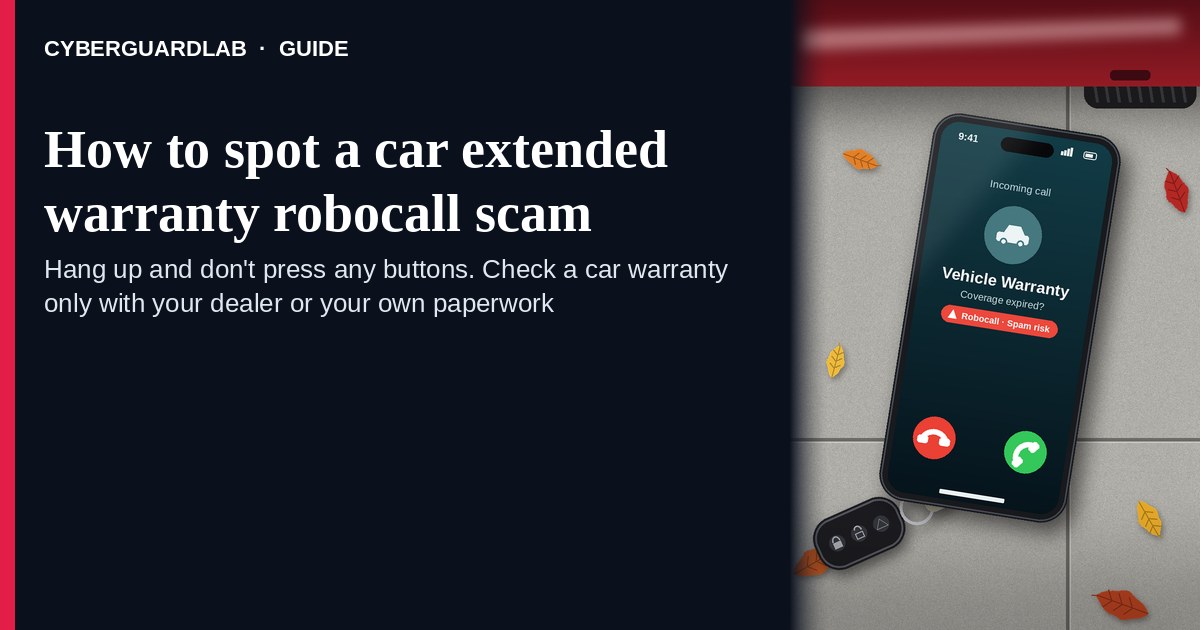
A car extended warranty robocall (or live cold call claiming your “vehicle warranty” expired) is usually a high-pressure pitch for a service contract you did not ask for — not proof that your factory coverage just died. The FTC has warned for years: hang up on auto warranty robocalls; sales robocalls you did not authorize in writing are almost always illegal; caller ID is easy to fake. Do not give a card number, VIN “to pull up the file,” Social Security number, or remote-access tool. Do not pay with gift cards, wire, crypto, or a payment app because a stranger on the phone told you to. If you already have a real manufacturer warranty, dealer plan, or service contract, verify it yourself with the paperwork, dealer, or manufacturer contact you already trust — never with the number in the robocall. This pattern is the vehicle cousin of the home warranty cold call scam. CyberGuardLab is independent. Referral fees may affect product placement on other pages. Buying nothing and sticking to free hang-up habits is a valid outcome. This page is not legal advice about your specific contract rights.
The short answer
Hang up on unexpected car-warranty or “coverage expired” robocalls; verify any real plan only with your dealer, manufacturer, or contract paperwork; never pay by gift card, wire, or remote access from a cold call.
What a car warranty robocall usually looks like
Scammers and aggressive telemarketers reuse the same fear: “your auto warranty / extended coverage expires today.” The job is not to protect your engine — it is to get payment details, a VIN, or enough personal data to keep selling.
Common shapes US households report:
- Robocall claiming the vehicle warranty file is “closing,” coverage lapsed, or the manufacturer required a renewal — often with a prompt to “press 1.”
- Live closer after you press a digit who asks for a card “to activate,” a deposit “today,” or your VIN and mileage “to quote.”
- Caller ID that looks local or shows a dealer-like name — spoofing is common; the display is not proof.
- Payment asks that legitimate renewals do not use from a cold call — gift cards, wire, crypto, cash apps, or remote desktop so they can “process the warranty.”
- Follow-up that morphs into tech support — “we need to check your PC for the warranty portal” is the tech support scam phone call playbook with a new opening line.
FTC robocall guidance is blunt: hang up; do not press numbers to “speak to someone” or “remove yourself”; register and report at DoNotCall.gov; report scams at ReportFraud.ftc.gov. The FTC’s auto-warranty alert matches the same hang-up playbook used for other service-contract pitches.
A real manufacturer warranty, certified-pre-owned plan, or dealer service contract you already bought is a different product. Keep the booklet. Renew or claim only through the company named on your paperwork, after you typed the URL or dialed the number yourself.
Auto warranty robocall vs home warranty cold call vs real coverage
| Signal | Car extended warranty robocall | Home warranty cold call / mailer | Coverage you already bought |
|---|---|---|---|
| Opening hook | “Your vehicle warranty expires today — renew or pay huge repair bills.” | “Your home warranty / appliance coverage expires today.” | You have a signed contract, policy ID, dealer, or manufacturer record. |
| Ask | Card on the spot, VIN, gift cards, wire, remote access, SSN “for the file.” | Card, gift cards, wire, remote access, SSN. | Renewal or claim through the vendor named on your paperwork. |
| Pressure | “Final notice,” fake manufacturer branding, countdown on the call. | “Final notice,” fake mortgage branding. | Normal billing calendar — not a stranger’s urgency. |
| Safe next step | Hang up. Check dealer / manufacturer / your contract. | Hang up. Check your own home contract / insurer contacts. | Use only contacts printed on your contract or statement. |
| Related guide | This page | Home warranty cold call scam | Your contract + FTC extended-warranty shopping tips |
If the caller demands gift cards, treat it like a gift card scam immediately — stop and hang up.
How to handle a car warranty robocall (US household steps)
Do this when any unexpected auto-warranty pitch appears. You do not need a paid product to finish these steps.
- Hang up. Do not press digits. Close the robocall or live pitch. Do not call back a number from the message. FTC robocall advice: hang up; pressing buttons often leads to more calls.
- Ignore payment, VIN-as-password, and remote-access asks. Card numbers, SSN, “activation fees,” gift cards, wires, crypto, cash apps, or AnyDesk/TeamViewer-style tools from a cold call are stop signs — not renewal steps. Sharing a VIN on a cold sales call is optional data you control; you do not owe it to a stranger who rang you.
- Check whether you already have coverage — yourself. Look at the glove-box warranty booklet, dealer service-contract paperwork, certified-pre-owned documents, or the manufacturer account you already use. Use only phone numbers and URLs printed on those documents or on the manufacturer’s / dealer’s known site.
- If you want a new service contract later, shop on your schedule. The FTC’s extended-warranty / service-contract guidance: compare cost vs likely repairs, read deductibles and exclusions, research the company, and get terms in writing. Do that on a calm day with a dealer or insurer you choose — not during a robocall.
- If you already paid or shared data, treat it as incident response. Contact your bank or card issuer to dispute charges; change passwords for any account you mentioned; if personal data was stolen, start at IdentityTheft.gov. Report the scam at ReportFraud.ftc.gov and report robocalls at DoNotCall.gov. Our checklist: How to report a scam to the FTC.
- Tell the household. Agree that nobody renews “car warranty” or “vehicle service contract” from a cold call, and that gift-card payment for a warranty is never valid.
Signs the pitch is fake or unsafe (scan table)
Use this as a quick pass before you spend money or time.
| Sign | Why it matters | What to do |
|---|---|---|
| You never bought an extended warranty / service contract | “Renewal” for coverage you do not have is a classic lure | Hang up; ignore the callback |
| Robocall says “press 1 to keep your warranty active” | Button presses often route you to more sales pressure | Hang up without pressing |
| Asks for gift cards, wire, crypto, or cash-app payment | Legitimate renewals do not collect that way from a cold call | Stop; see gift-card scam guide; report to FTC |
| Wants remote access “to process the warranty” | Tech-support takeover | Hang up; see tech-support guide |
| Threatens immediate loss of coverage, tow holds, or huge repair bills unless you pay now | Fear used to skip verification | End the contact; verify on your own paperwork |
| Caller ID looks local, “BMW / Ford / Toyota warranty,” or “dealer services” | Caller ID is easy to spoof | Do not trust the display; hang up |
Free habits that reduce the blast radius
You do not need a new subscription to lower damage if a warranty robocall gets through.
- Household rule: no vehicle warranty purchases from cold calls or unexpected robocalls.
- Keep real warranty / service-contract paperwork in the glove box or a folder so “expiring coverage” claims are easy to check.
- Register numbers on the National Do Not Call Registry and use carrier call-blocking / labeling — they reduce volume; they do not stop every scammer.
- Unique passwords and 2FA on email and bank accounts limit what a stolen card or SSN fragment can unlock.
- Optional antivirus / web filtering is a separate layer for malware after a bad click; it does not replace hanging up.
What this page is not
This page is not a ranking of extended-warranty brands, not a coupon page, and not legal advice about your specific vehicle contract or lemon-law rights.
It does not claim CyberGuardLab lab scores or “#1 anti-scam” ranks. It does not tell you to ignore a real renewal notice from a company named on a contract you already have — it tells you to verify there, not with the cold caller. Official reporting stays on ReportFraud.ftc.gov, DoNotCall.gov, and IdentityTheft.gov if personal data was stolen.
If you decide a paid extra is a real job
Most households can handle car-warranty robocalls with the free steps above. Open a paid page only if you already named a job — for example broader web filtering, cross-device AV, or identity alerts after you gave a scammer personal data — and you will actually use it.
- PC / Mac suite with phishing and web protections many households already compare: Norton plans (paid link; confirm renewal price).
- Independent-test–oriented suite option: Bitdefender plans (paid link).
- Household suite shopping starting point: TotalAV plans (paid link; confirm renewal).
- Multi-device bill under one vendor: McAfee plans (paid link; confirm device limit).
- Another suite path some homes already use: Avast plans (paid link).
Buying nothing beyond free hang-up and contract-check habits is still valid. Paid links above are on-site only.
FAQ
Is every car warranty call a scam?
Many are illegal or unwanted robocalls / high-pressure pitches. Even if someone is selling a real-looking service contract, you should never buy under cold-call pressure. Hang up and research on your own time using FTC extended-warranty shopping tips and a dealer or insurer you choose.
They know my car make / model / year. Doesn’t that mean it’s official?
No. Vehicle details are often inferred, bought on marketing lists, or guessed from common models. The FTC’s auto-warranty robocall alert treats the unexpected pitch itself as the red flag — not whether the script names a familiar brand.
They want gift cards or a wire to “keep coverage active.” What now?
Stop. That is a payment method scammers love. Read Gift card scam, hang up, and report at ReportFraud.ftc.gov.
How is this different from a home warranty cold call?
Same urgency and payment tricks; different product costume. Home pitches target appliance / home service contracts; auto pitches target vehicle warranties. Related: Home warranty cold call scam.
I already gave a card number or VIN on a warranty call. What should I do first?
Call the number on the back of your card to report possible fraud and dispute the charge. Change passwords for accounts you discussed. Report at ReportFraud.ftc.gov. If SSN or ID data was shared, use IdentityTheft.gov.
Do I need paid antivirus to stop these calls?
No. Spotting is a hang-up and verify-yourself habit. Antivirus can be an optional layer for malware after a bad click; it does not replace ending the call.