 Cyber
Cyber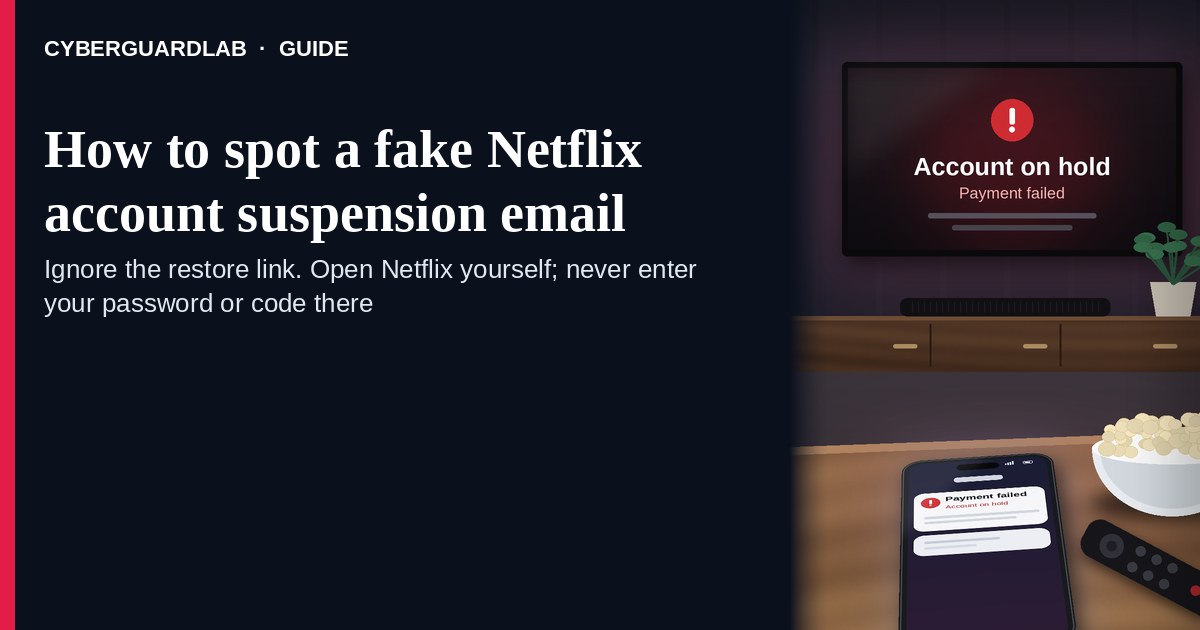
A fake Netflix account suspension email is an unexpected email, SMS, or push-style message that claims your Netflix account is “suspended,” that a payment “failed,” or that you must “confirm billing” or “restore streaming” through a link. Real Netflix billing and device activity live inside the account you open yourself at netflix.com or the official Netflix app — not inside a cold restore / confirm button. Netflix’s own phishing help page warns that look-alike messages try to steal passwords, payment details, and other personal information. This lure is about Netflix login and billing panic, not Google Play store billing (see Fake Google Play billing phishing). It covers “account suspended” and “payment failed” lures; if the message is a fake Netflix password-reset email instead, read Fake Netflix or streaming password-reset email. CyberGuardLab is independent. Referral fees may affect product placement on other pages. Buying nothing and sticking to free verification habits is a valid outcome.
The short answer
Ignore the restore / confirm / update-payment link in an unexpected “Netflix suspended” or “payment failed” message; verify only at netflix.com or the official Netflix app you open yourself; never enter your Netflix password or one-time code on a cold page.
What a fake Netflix account suspension usually looks like
Scammers copy Netflix membership language: “Your account has been suspended,” “Payment declined — update now,” “Unusual sign-in — confirm it’s you,” or “Restore streaming in 24 hours.” The job is credential theft, card theft, or both.
Common shapes US households report:
- Email claiming the account is suspended or payment failed with a bright “Restore account,” “Update payment,” or “Confirm billing” button that does not land on netflix.com.
- SMS or iMessage about a “Netflix payment problem” with a short link to “fix billing” or “keep watching.”
- Look-alike Netflix login page after you tap — then email, password, and often a one-time code harvest.
- Fake “unusual sign-in” or device alert that mixes real-looking device names with a cold “secure your account” link outside Netflix.
- Follow-up after any reply or tap — once you engage, expect more “Netflix support” emails or a scripted call. Related streaming / membership billing angle: Amazon Prime renewal scam.
FTC phishing guidance: do not click links in unexpected messages; if you think it might be real, contact the company with a website or phone number you know is real; report at ReportFraud.ftc.gov.
We do not claim Netflix “never emails about billing or security.” Netflix may send real payment and account notices. The safe habit is always the same: leave the unexpected message, open netflix.com or the official app yourself, and manage Account only inside a session you started.
Fake Netflix suspension vs real Netflix notice vs Google Play billing phishing
| Signal | Fake Netflix suspension / payment-failed message | Real Netflix account notice (typical) | Related Google Play billing phishing |
|---|---|---|---|
| Opening hook | “Account suspended — restore now / payment failed — update billing today.” | Billing or security details you can also see after you sign into Netflix yourself. | Unexpected Google Play / Play Store charge, refund, or “confirm purchase” lure — not Netflix. |
| Ask | Cold link, Netflix password, OTP, card, or “reactivation fee.” | Usually none inside the message — manage Account and Payment inside signed-in Netflix. | Cold Play Store / Google link, password, or card on a look-alike billing page. |
| Pressure | Same-day loss of streaming, “final notice,” restore countdown. | Normal Account timeline; you verify on your schedule. | Same-day “refund” or “dispute charge” urgency on a Play billing channel. |
| Safe next step | Ignore link. Type netflix.com or open the official app. | Confirm Payment method, devices, and recent activity only inside Netflix. | Verify only in the Google Account you open yourself. |
| Related guide | This page | netflix.com typed by you / official Netflix app | Fake Google Play billing phishing |
If the page after the tap asks for your Netflix password plus a one-time code or card on the same cold form, stop — that is credential theft dressed as a suspension alert.
How to verify a Netflix account suspension email (US household steps)
Do this when any unexpected Netflix suspension / payment-failed / confirm-billing message appears. You do not need a paid product to finish these steps.
- Do not tap the link, reply YES/NO, or call a number that lives only inside the message. Close the email or text. Do not discuss the “suspension” with a caller who contacted you first.
- Open Netflix the way you already trust. Type netflix.com yourself, use a bookmark you saved earlier, or open the official Netflix app already on your phone — not the restore / confirm link.
- Check Account, Payment, and devices only inside a signed-in session you started. Look at payment method status, recent device activity, and email on file. If nothing unexpected appears, treat the message as spam.
- Never enter your Netflix password, one-time code, or card on a page that arrived from a cold email or text. Legitimate Netflix account work does not require you to trust an unexpected shortener or look-alike domain. Do not send money or gift cards to “restore” streaming.
- If you already tapped, typed a password or code, or entered a card, treat the first hour as incident response. Change your Netflix password from netflix.com or the official app you open; review devices and payment method; turn on 2FA on the email that owns Netflix if it was off; call the number on the back of your card to watch for fraud. Follow Clicked a phishing link — first hour. Report at ReportFraud.ftc.gov; if identity data was stolen, use IdentityTheft.gov. Netflix also asks people to forward phishing emails to phishing@netflix.com when they can.
- Report the message and tell the household. Mark the email as phishing / junk; forward scam texts to 7726 (SPAM); file at ReportFraud.ftc.gov. Agree that nobody restores Netflix or “confirms billing” from unexpected links. Checklist: How to report a scam to the FTC. Strong unique passwords and 2FA on email and major accounts limit what a stolen Netflix password can unlock.
Signs the message is fake or unsafe (scan table)
Use this as a quick pass before you spend money or time.
| Sign | Why it matters | What to do |
|---|---|---|
| Restore / confirm / update-payment link lives only inside the unexpected message | Password and payment theft | Ignore; open netflix.com or the official app |
| URL is a shortener, misspelled Netflix name, or random form host | Phishing page | Never tap; type netflix.com |
| Urgent “restore in 15 minutes” or “account deleted tonight” | Fear used to skip verification | Slow down; check Account inside Netflix |
| Sender address is not a Netflix domain you recognize, or reply-to looks odd | Easy to spoof display names | Verify only inside a session you start |
| Page asks for Netflix password plus OTP / card on the same cold form | Credential + payment harvest | Stop; change password from official Netflix if you typed anything |
| You already replied, tapped, sent money, or spoke to a “Netflix agent” | Follow-up spam, malware, or account takeover risk | Stop engaging; verify on netflix.com; run first-hour steps if you entered secrets |
Free habits that reduce the blast radius
You do not need a new subscription to lower damage if a fake Netflix suspension alert gets through.
- Bookmark netflix.com (or keep only the official app); manage Account and Payment only there.
- Household rule: never use restore / confirm / update-payment links inside unexpected Netflix emails or texts; never send money or gift cards to “reactivate” a cold alert.
- Strong unique passwords + 2FA on email and Netflix limit what a stolen password can unlock.
- Forward obvious scam texts to 7726; enable carrier and mailbox spam filtering when available.
- Optional antivirus / web filtering is a separate layer after a bad tap; it does not replace the verify-on-netflix.com habit.
What this page is not
This page is not a guide to canceling a real Netflix plan, not a review of Netflix pricing tiers, and not legal advice about a specific disputed charge.
It does not claim CyberGuardLab lab scores or “#1 anti-phishing” ranks. It does not tell you to ignore a real payment problem you can also see inside your signed-in Netflix Account — it tells you to verify there, not in the cold message. It is not about Google Play store billing scams (see the related guide in the table above), and it is not the password-reset lure (that is Fake Netflix or streaming password-reset email). Official recovery and reporting stay with Netflix account security, your bank or card issuer, ReportFraud.ftc.gov, and IdentityTheft.gov if personal data was stolen.
If you decide a paid extra is a real job
Most households can handle fake Netflix suspension alerts with the free steps above. Open a paid page only if you already named a job — for example broader web filtering, cross-device AV, or identity alerts after you gave a scammer personal data — and you will actually use it.
- PC / Mac suite with phishing and web protections many households already compare: Norton plans (paid link; confirm renewal price).
- Independent-test–oriented suite option: Bitdefender plans (paid link).
- Household suite shopping starting point: TotalAV plans (paid link; confirm renewal).
- Multi-device bill under one vendor: McAfee plans (paid link; confirm device limit).
- Another suite path some homes already use: Avast plans (paid link).
Buying nothing beyond free official-site verification habits is still valid. Paid links above are on-site only.
FAQ
Does Netflix really email or text about suspensions or failed payments?
Netflix may send real payment and account notices. That is why the safe test is not “Netflix never messages,” but “I only check Account inside netflix.com or the official app I open myself.”
The message shows my name, plan name, or a case ID. Is that enough?
No. Names, plan labels, and case-like strings are easy to reuse from breaches, prior purchases, or guesswork. Trust the signed-in Netflix session you start yourself, not the message chrome.
I already entered my Netflix password on the restore page. What should I do first?
Change your Netflix password from netflix.com or the official app you open. Review devices and payment method. Turn on 2FA on the email that owns the account if it was off. Follow Clicked a phishing link — first hour. Report at ReportFraud.ftc.gov. Forward the phishing email to phishing@netflix.com when you can.
How is this different from a Google Play billing phishing message?
This page is about unexpected Netflix suspension / payment-failed / confirm-billing links. Fake Google Play billing phishing covers Play Store / Google purchase and refund lures. Same panic style, different account. Streaming membership renewals on Amazon are covered in Amazon Prime renewal scam.
How do I report a fake Netflix suspension email?
Mark the email as phishing / junk, forward it to phishing@netflix.com when your mailbox allows, forward scam texts to 7726 (SPAM), and file at ReportFraud.ftc.gov. Steps for the FTC side are in How to report a scam to the FTC.
Do I need paid antivirus to spot these alerts?
No. Spotting is a verification habit: ignore the link, open netflix.com or the official app, never enter secrets on a cold page. Antivirus can be a separate optional layer for malware after a bad tap; it does not replace that habit.