 Cyber
Cyber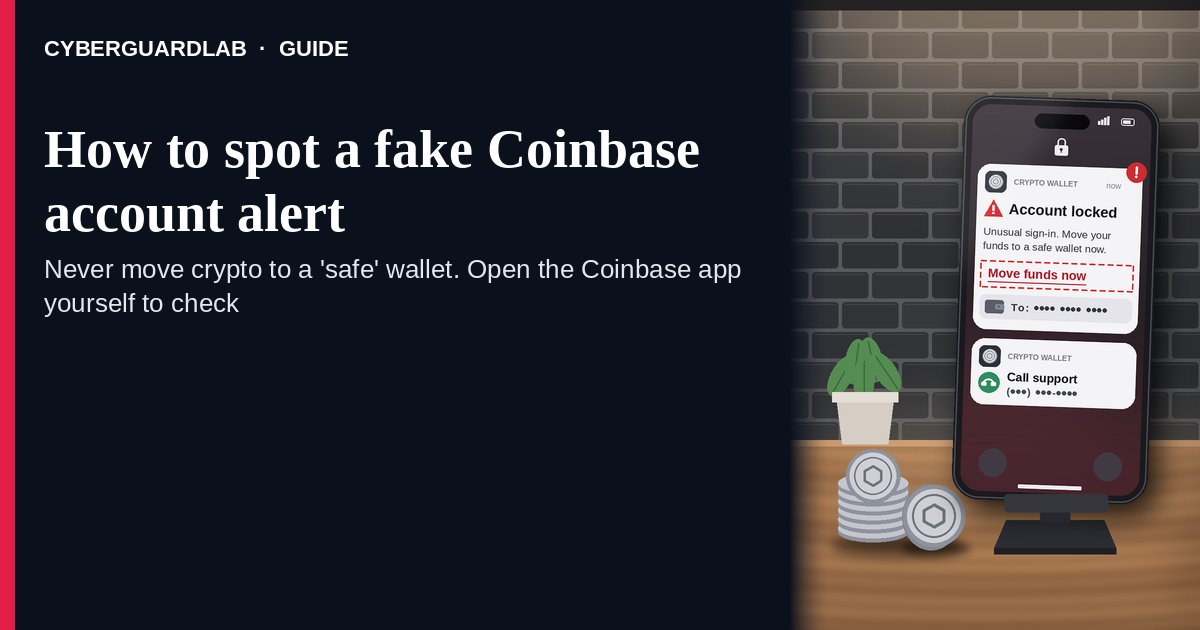
A fake Coinbase account alert is an unexpected text, email, or phone call that claims your Coinbase account is locked, compromised, or showing a suspicious withdrawal, and then pushes you to call a number, sign in through a link, read back a code, or move your crypto to a “safe” wallet. Coinbase’s own Help Center is direct about the ask: no one will ever ask for your password or 2FA codes, or ask you to transfer assets to a new address, account, vault, or wallet, and Coinbase says it will never call or text you to give you a new seed phrase or wallet address. The safe habit is to ignore the message, open the Coinbase app or type coinbase.com yourself, and if something feels off, lock your account in the app and contact Coinbase only through its own site. This page is about Coinbase-branded “account alert” texts, emails, and calls only. Investment and “guaranteed returns” crypto lures are in Cryptocurrency scam; the generic code-stealing phone call is OTP relay scam call. CyberGuardLab is independent. Referral fees may affect product placement on other pages. Buying nothing and sticking to free verification habits is a valid outcome.
The short answer
Never move crypto, share a code or password, or install an app because an unexpected “Coinbase” message or caller says your account is at risk. Open the Coinbase app or coinbase.com yourself; if something looks wrong, lock the account in the app and use Coinbase’s own Help Center.
What a fake Coinbase account alert usually looks like
The message creates fear that your crypto is about to disappear, then offers a fast “fix” that hands the scammer your login or your coins.
Common shapes US households report:
- Text about a withdrawal or new device you don’t recognize with a number to call or a link to “cancel” or “secure your account.”
- Email styled as a Coinbase security notice with a sign-in button that goes to a look-alike address (Coinbase’s Help Center gives examples such as swapping letters for numbers in the name).
- Phone call from “Coinbase security” or “support” — sometimes after you call a number from the text — saying your account is compromised and asking you to read back a code or share your password.
- “Move your funds to a secure wallet” — the caller gives you a new seed phrase, wallet address, or “vault” to send your crypto to. Coinbase says it will never do this.
- Install-this-app request — a screen-sharing or remote-access app so the “agent” can “help secure” the account. Same pattern as Fake Apple support screen-share scam, different brand.
Coinbase also notes that scammers can spoof legitimate phone numbers on outbound calls, so caller ID that says “Coinbase” proves nothing.
We do not claim Coinbase “never sends any email or text.” Real accounts get real security notifications. The safe habit is the same either way: leave the message, open Coinbase yourself, and never move funds or share secrets because someone contacted you.
Fake Coinbase alert vs real Coinbase notice vs related lure
| Signal | Fake Coinbase account alert | Real Coinbase notice (typical) | Related lure (crypto investment scam) |
|---|---|---|---|
| Opening hook | “Unusual withdrawal / account locked — call or sign in now.” | Activity you can also see after you open the Coinbase app or coinbase.com yourself. | “Guaranteed returns,” a mentor, or a trading platform you’ve never heard of. |
| Ask | Password, 2FA code, remote access, or move funds to a “safe” wallet. | Coinbase says it won’t ask for passwords, 2FA codes, or transfers to a new wallet. | Deposit more to “unlock” profits or pay “taxes” (see Cryptocurrency scam). |
| Pressure | “Your funds will be lost in minutes.” | You check on your schedule inside the app. | Fear of missing out; deadlines to invest. |
| Safe next step | Hang up / ignore. Open the app yourself; lock the account if worried. | Review activity inside the app you opened. | Stop sending money; see Cryptocurrency scam. |
| Related guide | This page | Coinbase app / coinbase.com typed by you · Coinbase Help Center | Cryptocurrency scam |
If anyone gives you a wallet address or seed phrase and tells you to send your crypto there for safety, stop. Coinbase says it will never call or text you to do that.
How to verify a Coinbase account alert (US household steps)
Do this when any unexpected Coinbase withdrawal, lock, or security message or call appears. You do not need a paid product to finish these steps.
- Do not call the number, tap the link, reply, or stay on the line. If someone called you, hang up. Coinbase’s Help Center says it will never ask you to contact an unknown number to reach it.
- Open Coinbase the way you already trust. Open the Coinbase app you installed earlier or type coinbase.com yourself, sign in, and look at recent activity and devices. Do not use the sign-in button in the message.
- If anything looks wrong — or you just feel uneasy — lock first. Coinbase’s advice is “lock first, ask later”: lock your account in the app, then contact Coinbase only through its Help Center. Coinbase lists security@coinbase.com for urgent security reports.
- Never share your password, 2FA codes, or seed phrase, never install remote-access apps, and never move funds to a wallet someone else gives you. Coinbase says no one will ever ask for these. A caller who does is a scammer, no matter what the caller ID shows. More on code theft by phone: OTP relay scam call.
- If you already shared a code, signed in on a fake page, or sent crypto, treat the first hour as incident response. Lock the account in the app, change your Coinbase and email passwords from a device you trust, remove any app the caller had you install, and follow Clicked a phishing link — first hour. Report crypto losses at ReportFraud.ftc.gov and the FBI’s IC3. Crypto transfers are usually hard to reverse, so speed matters.
- Report the message and tell the household. Send the phishing URL or a screenshot of the text to security@coinbase.com (per Coinbase’s reporting page), forward scam texts to 7726 (SPAM), and file at ReportFraud.ftc.gov. Agree that nobody moves crypto because of a call or text. Checklist: How to report a scam to the FTC.
Signs the alert is fake or unsafe (scan table)
Use this as a quick pass before you touch your account.
| Sign | Why it matters | What to do |
|---|---|---|
| Message says to call a number to stop a withdrawal | Routes you to a fake “support” line | Ignore; open the Coinbase app yourself |
| Sign-in link goes to a look-alike address | Phishing page that steals your login | Never tap; type coinbase.com |
| Caller asks for a 2FA code or password | Account takeover in progress | Hang up; Coinbase says no one will ask |
| Caller gives you a new wallet address or seed phrase | Your crypto goes straight to the scammer | Stop; never move funds on instruction |
| Asked to install a screen-sharing app | Full view and control of your device | Refuse; hang up |
| Caller ID says “Coinbase” | Numbers can be spoofed | Treat caller ID as proof of nothing |
Free habits that reduce the blast radius
You do not need a new subscription to lower damage if a fake Coinbase alert gets through.
- Open Coinbase only from the app you installed or a bookmark for coinbase.com — never from a message.
- Use the strongest two-step option you can; Coinbase recommends hardware security keys or passkeys. Setup ideas: Hardware security key for main accounts.
- Coinbase suggests using an email address only for your Coinbase account, which makes it harder for scammers to connect your data.
- Household rule: nobody moves crypto, reads a code, or installs an app because of an unexpected call or text.
- Optional antivirus or web filtering is a separate layer after a bad tap; it does not replace the open-it-yourself habit. Built-in Microsoft Defender plus those habits is enough for many households.
What this page is not
This page is not investment advice, not a review of Coinbase or other exchanges, and not a guide to recovering a specific stolen transfer.
It does not claim CyberGuardLab lab scores or “#1 anti-phishing” ranks. It does not tell you to ignore real activity you can also see inside the Coinbase app — it tells you to check there, not in the cold message. It is not the crypto investment or “pig butchering” guide (see Cryptocurrency scam). Official recovery and reporting stay with Coinbase’s Help Center, ReportFraud.ftc.gov, IC3, and IdentityTheft.gov if personal data was stolen.
If you decide a paid extra is a real job
Most households can handle fake Coinbase alerts with the free steps above. Open a paid page only if you already named a job — for example broader web filtering, cross-device AV after a remote-access install, or identity alerts after you gave a scammer personal data — and you will actually use it.
- PC / Mac suite with phishing and web protections many households already compare: Norton plans (paid link; confirm renewal price).
- Independent-test–oriented suite option: Bitdefender plans (paid link).
- Household suite shopping starting point: TotalAV plans (paid link; confirm renewal).
- Multi-device bill under one vendor: McAfee plans (paid link; confirm device limit).
- Another suite path some homes already use: Avast plans (paid link).
Buying nothing beyond free open-it-yourself habits is still valid. Paid links above are on-site only.
FAQ
Does Coinbase call customers about account problems?
Coinbase’s Help Center says it will never call or text you to give you a new seed phrase or wallet address, and that no one will ever ask for your password, 2FA codes, or a transfer to a new wallet. Treat any call that asks for those as a scam and hang up.
The caller knew my name and my balance. Doesn’t that prove it’s Coinbase?
No. Personal details leak through data breaches and other sources, and caller ID can be spoofed. Trust only what you see inside the Coinbase app or coinbase.com you open yourself.
I already gave a 2FA code or signed in on a link. What should I do first?
Lock your account in the Coinbase app, change your Coinbase and email passwords from a trusted device, and contact Coinbase through its Help Center (security@coinbase.com for urgent security reports). Follow Clicked a phishing link — first hour and report at ReportFraud.ftc.gov.
I sent crypto to the “safe wallet.” Can I get it back?
Crypto transfers are usually hard to reverse. Report right away to Coinbase, ReportFraud.ftc.gov, and IC3 with transaction details. Be wary of anyone who then contacts you offering to “recover” your crypto for an upfront fee.
How do I report a fake Coinbase alert?
Email the phishing URL or a screenshot of the text to security@coinbase.com, forward scam texts to 7726 (SPAM), and file at ReportFraud.ftc.gov. Steps for the FTC side are in How to report a scam to the FTC.
Do I need paid antivirus to spot these alerts?
No. Spotting is a habit: ignore the message, open Coinbase yourself, never share codes or move funds on instruction. Microsoft Defender plus those habits is enough for many households. Antivirus can be an optional layer after a bad install; it does not replace that habit.